De-Escalating Difficult Encounters
An immersive decision-tree VR simulation designed to strengthen communication, judgment, and de-escalation skills during difficult patient and caregiver encounters. Learners navigate realistic interactions, choose responses at critical moments, and receive detailed scoring and feedback across empathy, active listening, safety, communication, sequencing, escalation, and resolution. Coming soon, the program will also be available as an AI-enabled Digital Clinical Twin experience, featuring live interactions, adaptive responses, real-time performance updates, and individualized scoring based on the learner’s words, decisions, and actions.
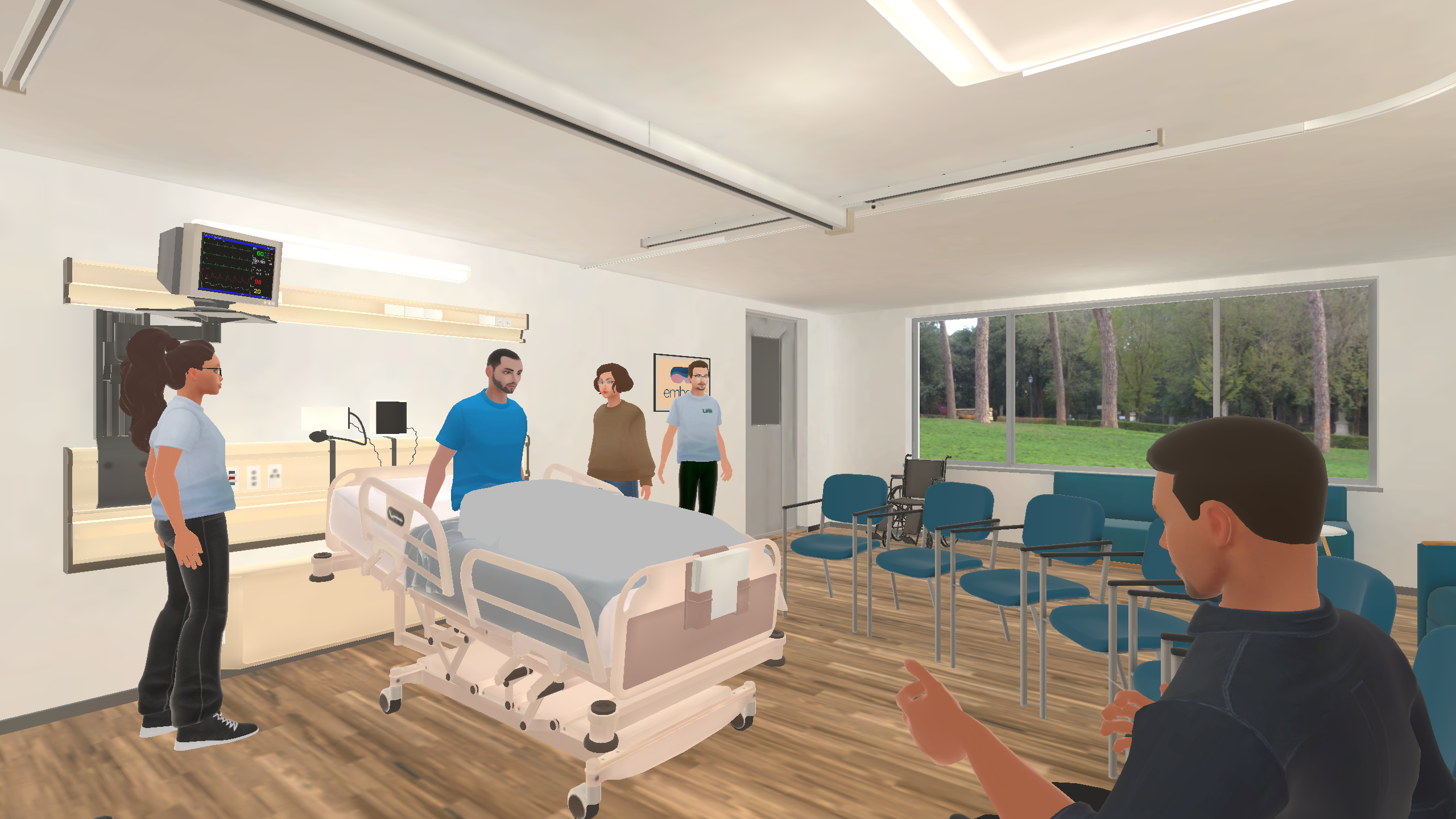
De-Escalating Difficult Encounters is an immersive VR simulation designed to help healthcare professionals respond more effectively to angry, frustrated, or emotionally distressed patients and caregivers. Through a structured decision-tree experience, learners navigate a realistic clinical interaction, choose how to respond at key moments, and see how their decisions influence the encounter's direction and outcome.
The program evaluates performance across essential de-escalation competencies, including empathy, active listening, emotional validation, communication clarity, personal and team safety, sequencing, boundary setting, escalation, and resolution. Learners receive detailed scoring and feedback that identify both effective actions and missed opportunities, helping them strengthen judgment, confidence, and consistency in high-pressure situations.
Coming soon, the program will also be available in an AI-enabled Digital Clinical Twin modality. In this advanced format, the patient or caregiver is represented as a dynamic digital clinical twin that can respond in real time to the learner’s words, tone, decisions, and actions. Rather than following only a fixed sequence of prewritten choices, the interaction can evolve continuously based on learner performance, changes in emotional intensity, and the clinical context.
AI-enabled scoring will assess the quality and timing of the learner’s communication, recognize effective and ineffective de-escalation behaviors, and provide real-time performance updates throughout the encounter. The system can also generate a personalized evaluation report highlighting strengths, red flags, missed steps, escalation decisions, and recommended areas for improvement.
This approach reflects the emerging definition of a digital clinical twin: an interactive, data-informed virtual representation of a patient, caregiver, or clinical situation that changes in response to real-time inputs. By combining immersive simulation, live interaction, adaptive scenario behavior, and measurable performance analytics, the program supports more realistic practice, more individualized feedback, and stronger preparation for difficult clinical encounters.